
Reviewed · LEONARDO DA VINCI TOURS
Milan: Leonardo3 The World of Leonardo Museum Entry Ticket
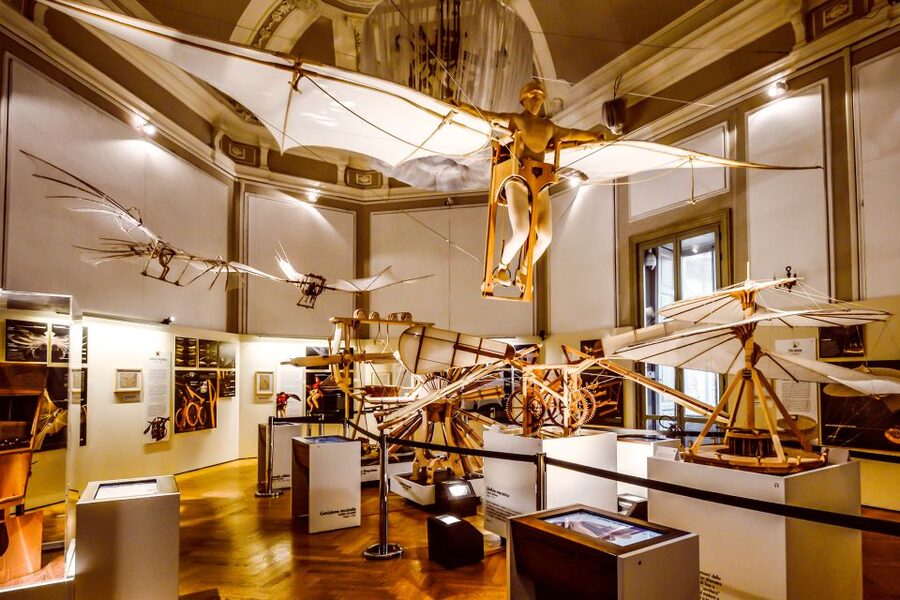
Leonardo3 turns Leonardo da Vinci’s small, cramped manuscript sketches into working machines you can see, study, and sometimes operate. The exhibition’s best trick is showing how an idea on paper becomes a three-dimensional model, from flying machines to military devices and stage inventions. The 3D codex displays make his notes far easier to understand than a page of mirror writing.
I especially like the working models and the digital treatment of The Last Supper. I also like that children have hands-on tasks, including building a wooden bridge and printing an inventor’s certificate. The main drawback is space: several rooms can feel tight, and popular interactive stations may be difficult to reach when the museum is busy.
In This Review
- Key points
- Leonardo’s ideas become working machines
- Start with the 3D codex displays
- From war machines to flight
- Water, cities, and practical engineering
- The digital Last Supper
- Art, anatomy, and Leonardo’s wider mind
- A good stop for children and curious adults
- How much time should you allow?
- Location and practical details
- Is the audio guide worth choosing?
- Who will enjoy Leonardo3 most?
- Should you book Leonardo3?
- FAQ
- Where is Leonardo3 located?
- How long is the ticket valid?
- Is an audio guide included?
- What languages are used in the interactive exhibits?
- Is Leonardo3 suitable for children?
- Is the museum wheelchair accessible?
- Can I bring food, drinks, or a camera?
Key points
- More than 200 reconstructed machines: See practical models based on Leonardo’s manuscripts, including flight, canal, military, mechanical, and theatrical designs.
- A working mechanical dragonfly: Interactive machines help you understand motion instead of simply looking at silent objects behind glass.
- Digital Last Supper restoration: Examine details of Leonardo’s famous mural and view an optional reconstructed setting.
- Multilingual audio guide: Choose the audio option for explanations in English, Italian, Russian, German, French, Spanish, Portuguese, or Chinese.
- Hands-on family activities: Build a self-supporting wooden bridge or print an inventor’s certificate in the children’s workshop area.
- Easy central location: Enter through the Galleria Vittorio Emanuele II from Piazza della Scala, right in the center of Milan.
Leonardo’s ideas become working machines
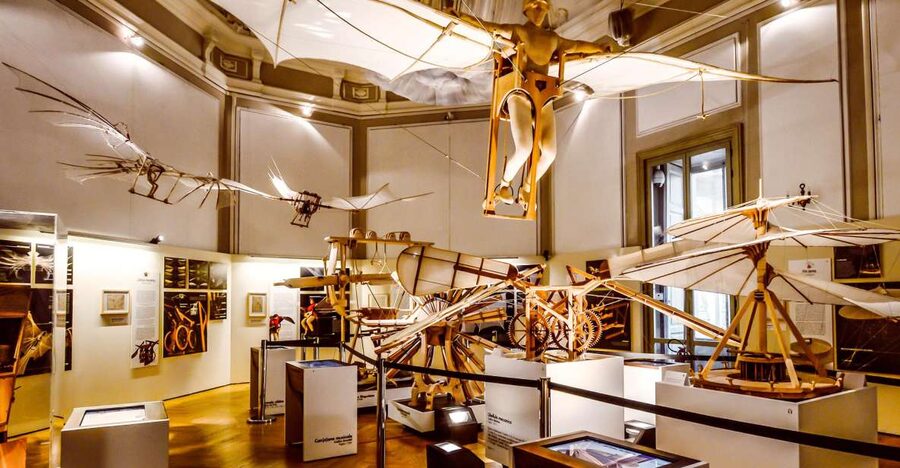
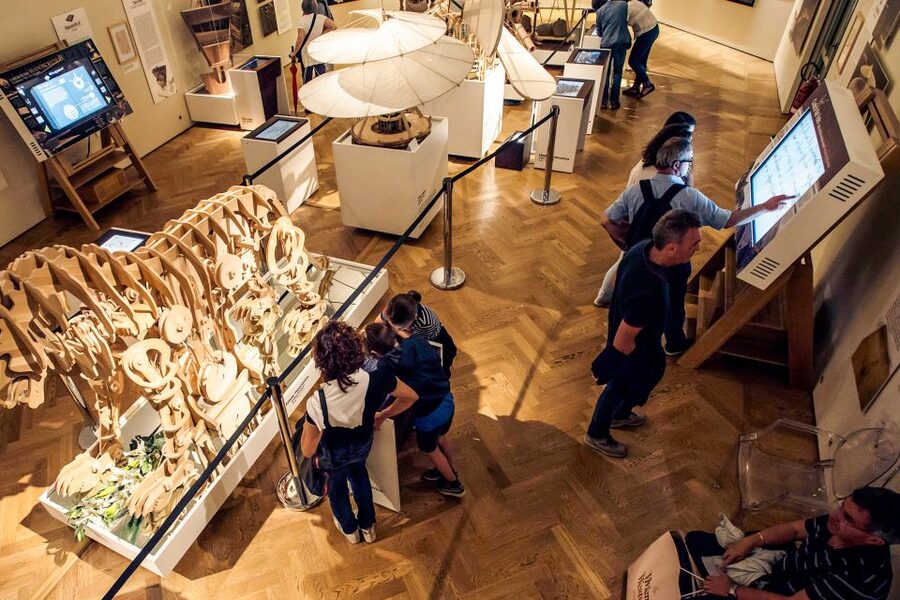
The central pleasure of Leonardo3 is simple: you do not just read that Leonardo imagined a flying machine, a weapon, or a mechanical device. You see a reconstruction based on his drawings and notes, often with moving parts or an interactive screen explaining how it works.
Leonardo left behind thousands of pages filled with observations, diagrams, engineering ideas, and artistic studies. Those pages are often fascinating but not easy to read. His handwriting can be reversed, his drawings can be partial, and his notes may assume that the reader already understands the mechanism.
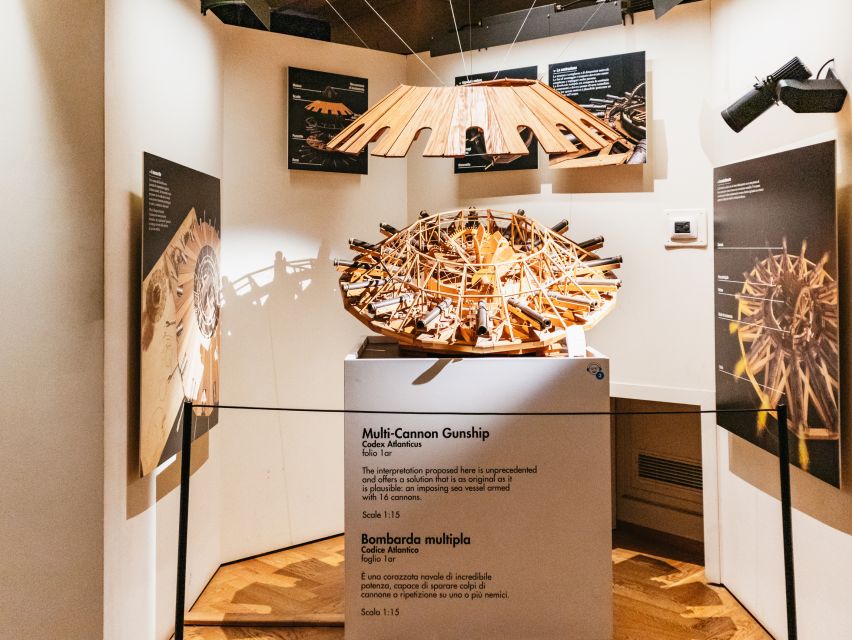
This museum acts as a bridge between the manuscript and the machine. The research team has studied the codices, interpreted the drawings, and built three-dimensional versions. Some of these reconstructions are fully functioning, while others are presented through digital animation or interactive displays.
I find this approach more useful than a traditional collection of portraits and reproductions. You can see the thought process. A line in a notebook becomes a gear, wing, bridge, weapon, or lifting device. That is the point of Leonardo3, and it gives the exhibition a clear purpose.
More Leonardo da Vinci trails:
- Best of Milan Experience Including Da Vinci’s The Last Supper and Milan Duomo
★ 4.5 · 1,516 reviews - Milan: Guided Tour of Leonardo da Vinci’s ‘The Last Supper’
★ 4.6 · 1,281 reviews - Milan: Leonardo’s Last Supper Guided Tour
★ 4.6 · 685 reviews
Start with the 3D codex displays
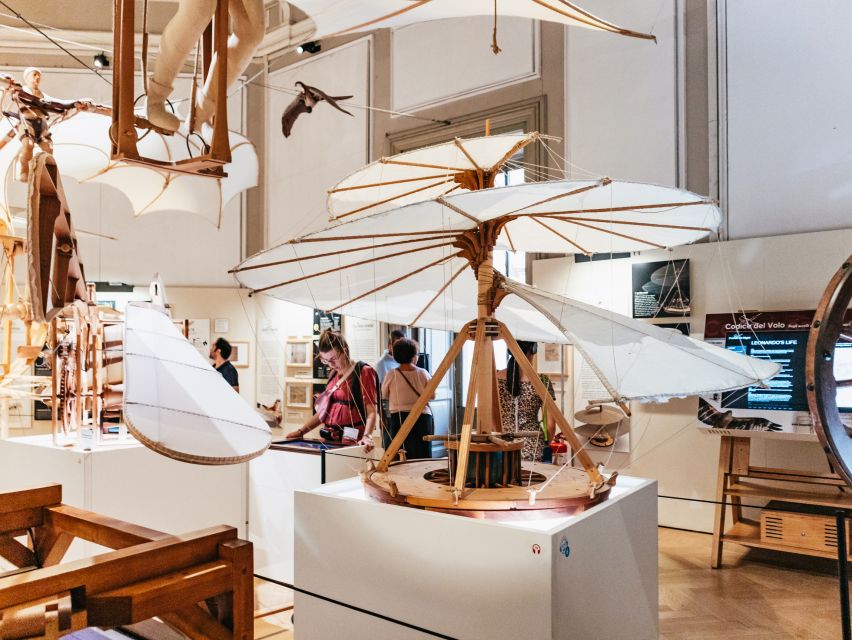
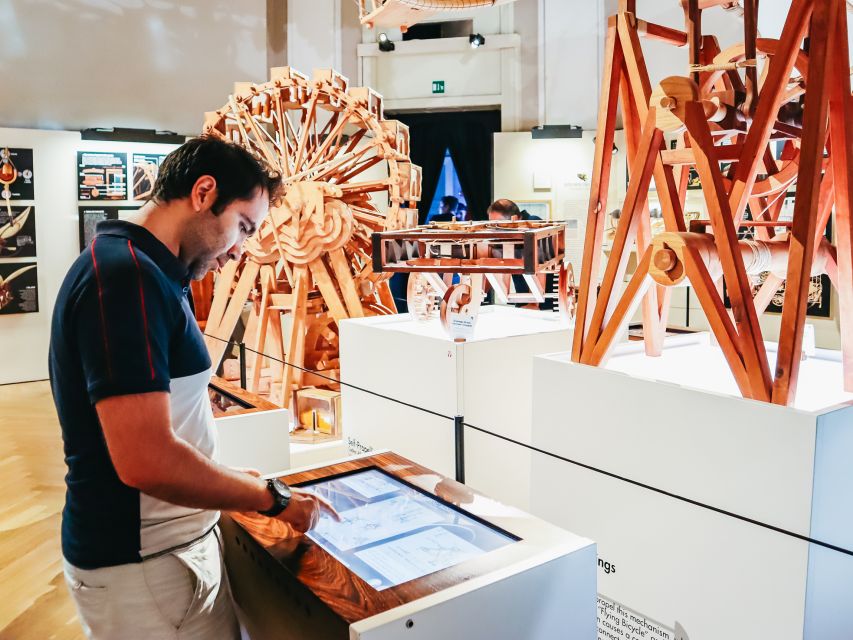
The digital codex material is one of the strongest parts of the visit. Instead of studying a flat manuscript page from a distance, you can examine Leonardo’s drawings in a more active format and see how the research team translated his ideas into models.
The displays help explain details that might otherwise pass unnoticed. You can follow the relationship between a sketch and the machine it describes, then see how motion, balance, or force might work in practice. This is especially helpful if you have little background in engineering.
The exhibition also gives you a better sense of Leonardo’s range. He was not focused on one narrow subject. His notes move between painting, mechanics, architecture, military design, water management, flight, theater, and anatomy. The displays bring these interests together without requiring you to read a lengthy book before your visit.
If you choose the audio guide, plan to use it. The extra explanations add context to the machines and help you understand why a particular design matters. Audio is available in English, Italian, Russian, German, French, Spanish, Portuguese, and Chinese, while the interactive experiences themselves are in English and Italian.
From war machines to flight
The machine galleries cover some of Leonardo’s most famous technical ideas. You can expect reconstructions connected with military equipment, including submarines, machine guns, and crossbows. These exhibits are not presented as modern inventions in the strict sense. They show what Leonardo proposed, how he pictured the mechanism, and how the museum’s experts interpreted his drawings.
That distinction matters. Leonardo’s sketches were often exploratory. A drawing does not always prove that he built or tested the finished device. The models are best understood as informed reconstructions of his ideas, not as original objects from the Renaissance.
The military section also gives useful historical context. Italy was not yet a united country, and city-states faced ongoing security concerns. Leonardo’s engineering work was tied not only to curiosity but also to civic and military needs. His designs for defense, transport, and urban life reflect the pressures of the period.
The flight displays are likely to appeal to anyone interested in how humans first imagined controlled movement through the air. You can see the basic problem Leonardo was trying to solve: how to create lift, power, and control with the materials and mechanics available to him.
The exhibition does not need to claim that Leonardo invented modern aviation. Its real value is showing how he observed nature, tested possibilities on paper, and used mechanical thinking to approach a difficult problem.
Water, cities, and practical engineering
Leonardo’s work with canals and urban planning adds welcome variety to the better-known flying machines and weapons. These sections show his interest in making civic life more efficient and organized.
The canal projects are particularly useful for understanding Leonardo as an engineer rather than only as an artist. Water control required careful thinking about levels, flow, locks, transport, and construction. These designs connect his imagination with very practical needs.
You can also find material related to the production of the horse memorial. This part gives you a glimpse of the scale of his ambitions and the difficulty of turning an enormous artistic idea into a physical monument.
I like these sections because they prevent the museum from becoming a parade of spectacular inventions. Leonardo was not only dreaming up machines for the future. He was working on real problems involving movement, construction, water, defense, and public space.
A few more Milan trips worth weighing up
- Milan: La Scala Theater & Museum Guided Experience
★ 4.1 · 2,931 reviews - Milan: La Scala Theater and Museum Tour with Entry Tickets
★ 4.7 · 1,722 reviews - Milan: Cathedral, Archeological Area and Museum Ticket
★ 4.5 · 1,093 reviews - Casa Milan: Museum Entry Ticket
★ 4.6 · 969 reviews
The digital Last Supper
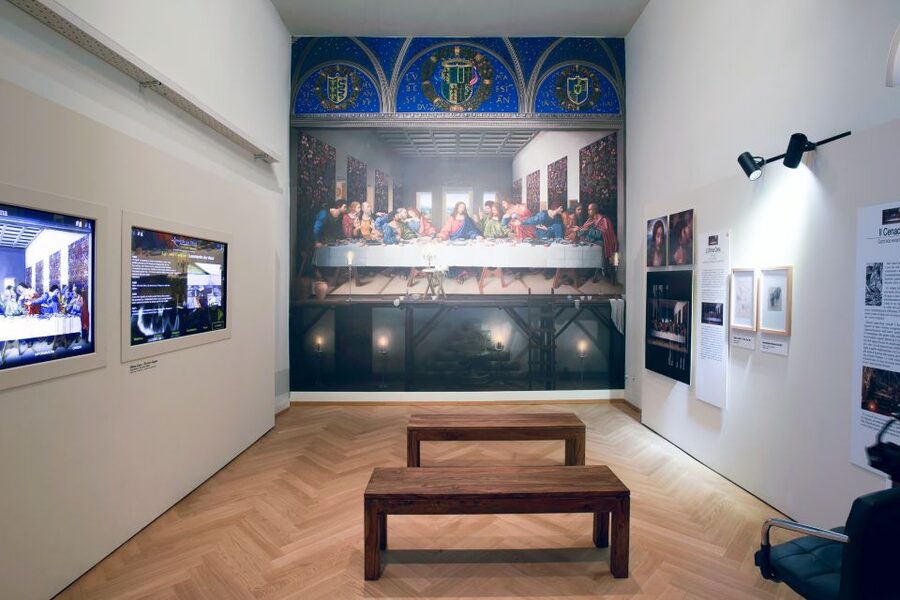
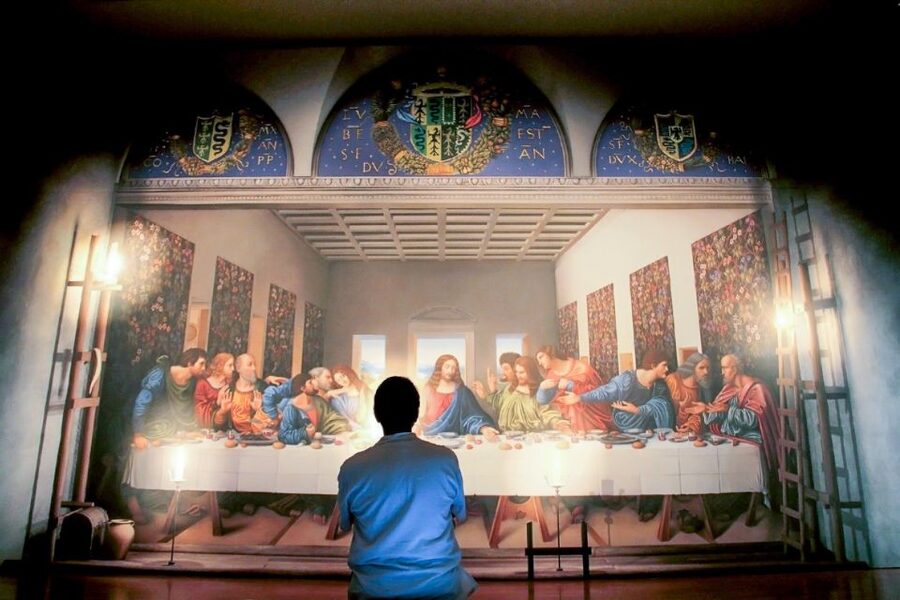
The Last Supper section is a major reason to visit, especially if you cannot get a booking for the original mural at Santa Maria delle Grazie. It is not a replacement for seeing Leonardo’s actual painting, but it gives you a different way to study the work.
The digital restoration lets you examine details of the wall painting in a format designed for close inspection. An optional three-dimensional reconstruction of the setting adds another layer, helping you picture the room and the relationship between the painting and its surroundings.
The value here is access. The original Last Supper is fragile, and visits to the actual refectory are tightly controlled. At Leonardo3, you can spend more time considering the composition, restoration, and details without treating the original artwork as if it were a normal museum object.
Keep your expectations sensible. A digital reconstruction is an interpretation, not the physical painting. One part of the presentation uses computer-generated versions that may feel more logical than emotionally convincing. I would treat this section as a study tool and companion experience, not a substitute for Leonardo’s original work.
If you already have a reservation for Santa Maria delle Grazie, the two visits complement each other. The church gives you the original setting and painting. Leonardo3 gives you more freedom to explore the technology, restoration, and structure behind it.
Art, anatomy, and Leonardo’s wider mind
The exhibition includes material connected with Leonardo’s art, including references to the Vitruvian Man, the Mona Lisa, and Lady with an Ermine. These pieces help place the machines within his larger body of work.
Some visitors will find this art section less compelling than the mechanical displays. I can understand that reaction. Milan has major art collections, and the museum’s most distinctive contribution is its reconstruction of Leonardo’s ideas, not its reproduction of familiar paintings.
Still, the art material matters because it shows how closely Leonardo linked artistic observation and scientific study. His attention to proportion, anatomy, movement, and light served both the painter and the engineer.
You may also find anatomy-related material and animated presentations that connect the human body with Leonardo’s interest in motion and structure. The exhibition works best when it lets you compare these different sides of his thinking rather than separating the artist from the inventor.
A good stop for children and curious adults
The children’s workshop area gives younger visitors something to do with their hands. They can assemble a self-supporting bridge from wooden parts or print an inventor’s certificate.
These activities are not just filler. The bridge exercise introduces balance and structure in a way that makes sense without a lecture. It also gives children a break from reading labels and waiting for adults to finish with an interactive display.
The museum is often suitable for children aged about eight and up, particularly those who like science, building, machines, or drawing. Younger children may enjoy the moving models, but the written explanations and historical context may be harder to follow.
Adults should not skip the workshop automatically. Building a simple structure can make Leonardo’s engineering ideas clearer, and it adds a welcome change of pace after several screens and display cases.
How much time should you allow?
You can see the main displays in about an hour if you move briskly. I would allow 90 minutes to two hours for a comfortable visit, especially if you use the audio guide and stop at the interactive stations.
A particularly interested visitor could spend around two and a half hours. That amount of time makes sense if you read the explanations, study the codex material, explore the Last Supper section, and allow children to use the workshop.
The exhibition is compact rather than enormous. That is helpful if you are fitting it between Milan sights, but it also explains the most common practical complaint: the rooms can feel crowded with objects and people. The displays sometimes sit close together, and an interactive station may be hard to access at a busy moment.
I would avoid rushing through at the busiest time if you want to use the machines. Since the ticket is valid for one day and availability includes starting times, check the booking details before you go and choose a slot that fits your Milan plans.
Location and practical details
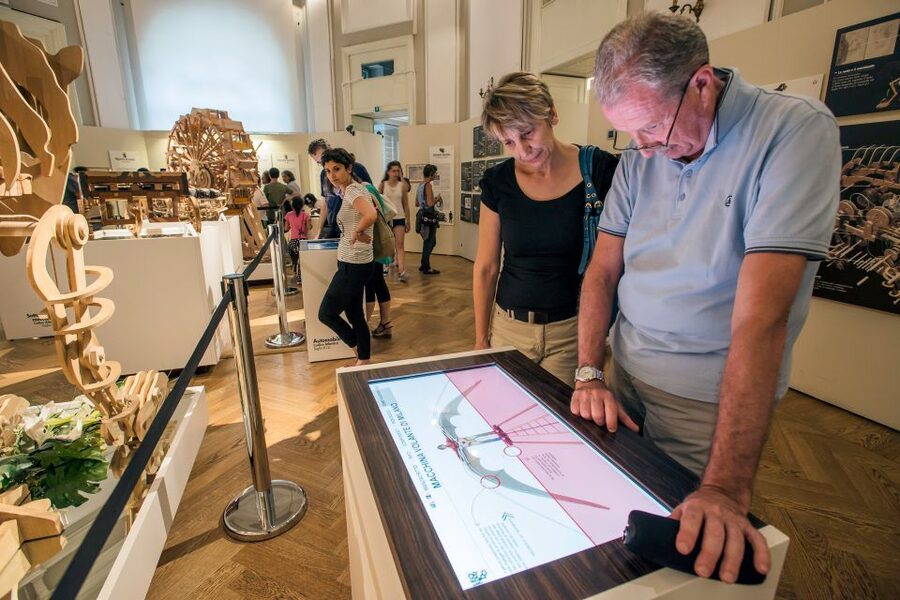
The museum is in an excellent central position. Enter through the Galleria Vittorio Emanuele II from Piazza della Scala, then show your ticket at the ticket office.
This location makes Leonardo3 easy to combine with a walk through the Galleria and a visit to the surrounding central sights. Transportation to the museum is not included, so you make your own way there.
The museum is wheelchair accessible. Food and drinks are not allowed inside, and cameras are also prohibited, so do not plan on photographing the machines or digital displays.
The ticket costs about $18 per person. For a central Milan attraction with working models, digital restorations, and a multilingual audio option, I consider that a fair price. The value improves if you spend at least 90 minutes inside and use the interactive material rather than treating it as a quick photo stop.
You also receive a 10 percent discount on books at the museum bookshop when you show your booking voucher. Souvenirs are not included, but books may be worthwhile if you want to continue with Leonardo’s drawings and inventions after leaving.
Is the audio guide worth choosing?
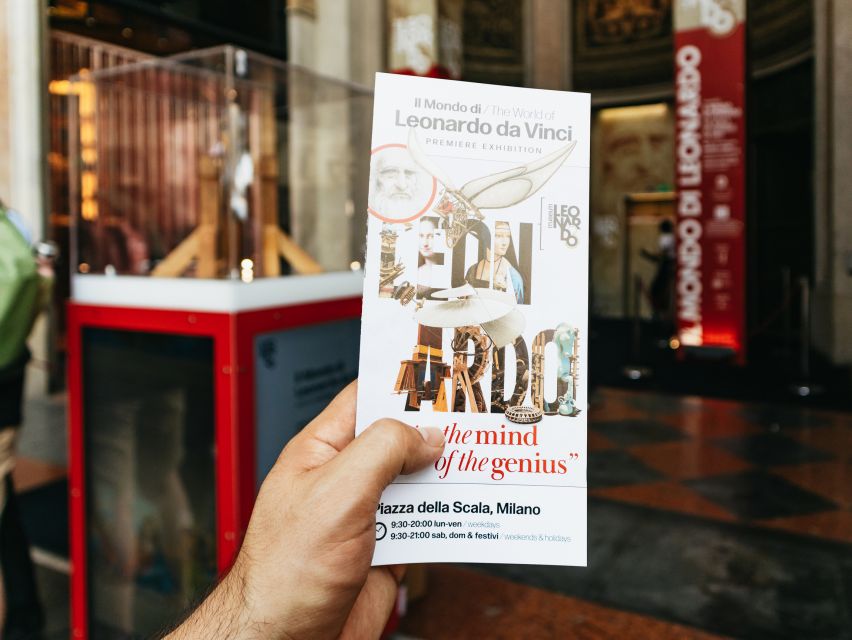
I would choose the audio guide, especially on a first visit. The machines can look impressive on their own, but the explanations tell you what you are seeing, how it relates to Leonardo’s notes, and what the reconstruction is meant to demonstrate.
It is also useful if you do not speak Italian. The interactive experiences are in English and Italian, while the audio guide offers eight language choices.
Without audio, you can still explore the museum and use the displays. But the exhibition contains a lot of detail, and the audio helps turn a collection of clever models into a connected story about Leonardo’s methods and interests.
Who will enjoy Leonardo3 most?
I would recommend this experience to:
- People fascinated by Leonardo da Vinci’s inventions and notebooks
- Families with children interested in building and science
- Visitors who want an alternative to a traditional art museum
- Anyone unable to secure a visit to the original Last Supper
- Adults who enjoy engineering, design, mechanics, or Renaissance history
- People looking for a central Milan attraction lasting one to two hours
It may be less satisfying if you want to see original Renaissance paintings or a large collection of historic objects. Much of what you see here consists of modern reconstructions, digital material, and interactive presentations.
That is not a weakness by itself. It simply means you should visit for interpretation and access to ideas, not for original Leonardo artifacts.
Should you book Leonardo3?
Yes, if you want to see how Leonardo’s drawings can be turned into understandable, working models. The combination of 3D codex displays, mechanical reconstructions, the digital Last Supper, and family activities gives you more to do than a basic exhibition of reproductions.
Choose the audio guide if you want the fullest experience, and allow at least 90 minutes. Families should leave time for the bridge-building workshop, while serious Leonardo fans may want two hours or more for the codex and invention sections.
I would not book it as a substitute for the original Last Supper if you already have access to Santa Maria delle Grazie. I would book it as a companion, or as a strong alternative when the original painting is sold out. At $18, it offers a focused, central, and unusually hands-on look at the working mind of Leonardo da Vinci.
FAQ
Where is Leonardo3 located?
Leonardo3 is entered through the Galleria Vittorio Emanuele II in Piazza della Scala, in central Milan.
How long is the ticket valid?
The ticket is valid for one day. Check availability for the starting times offered when you book.
Is an audio guide included?
An audio guide is available if you select the option that includes it. Languages include Italian, English, Russian, German, French, Spanish, Portuguese, and Chinese.
What languages are used in the interactive exhibits?
The interactive experiences are available in English and Italian.
Is Leonardo3 suitable for children?
Yes. Children can use the workshop area to assemble a self-supporting wooden bridge or print an inventor’s certificate. The interactive displays also make the exhibition suitable for children interested in science and machines.
Is the museum wheelchair accessible?
Yes, the experience is wheelchair accessible.
Can I bring food, drinks, or a camera?
No. Food and drinks are not allowed, and cameras are also prohibited inside the museum.
Just added around Milan
- Milan: Food Tour with Pasta, Pizza, Cannoli, and Tiramisu!★ 4.3 · 3 reviews
- Varenna Walking Tour and Cooking Class★ 5.0 · 3 reviews
- 1-Day Personal Fashion Styling Course for Women★ 5.0 · 3 reviews
- Milan: 4-Hour Art and History Private Walking Tour★ 5.0 · 3 reviews
- Private Wine Tasting in Bellagio with Chef Luigi Gandola★ 5.0 · 3 reviews
- Walking Tour in Lake Como with Lierna Cooking Class★ 5.0 · 3 reviews
- Mantova: Private Walking Tour★ 4.3 · 3 reviews
- Wine and Food tasting PRIVATE Guided Tour★ 5.0 · 3 reviews
Leonardo da Vinci Tours, compared.
Best of Milan Experience Including Da Vinci’s The Last Supper and Milan Duomo
Read our review →
Guided Tour of Leonardo da Vinci’s ‘The Last Supper’
Read our review →
Leonardo’s Last Supper and Michelangelo’s Pietà Tour
Read our review →
Experience Da Vinci’s Last Supper: Tickets & Guided Tour
Read our review →
Da Vinci’s Last Supper Express Semi-Private Guided Tour
Read our review →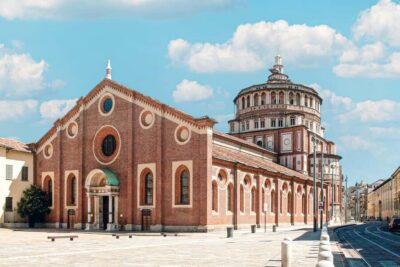
Browse the lists this tour appears in