Reviewed · GUIDED
Milan Skyscrapers Guided Tour: Porta Nuova, Unicredit tower & Vertical Forest
Milan’s modern face comes into focus in Porta Nuova, where the Unicredit Tower rises above Gae Aulenti Square and Isola’s tree-covered apartment towers turn urban planting into architecture. This private, three-hour walk connects those headline sights with the older streets and courtyard homes nearby.
I like the personal format, especially if you want to ask questions about design rather than follow a large group. I also like the clear contrast between Corso Como, the Vertical Forest, and Isola’s older railing houses. The main consideration is price: at $265.09 per person, this makes the most sense for a small group that values a private guide and focused discussion.
In This Review
- Key points to know before booking
- Why Milan’s modern district deserves a walking tour
- Starting at Eataly Milano Smeraldo
- Walking through Porta Nuova after the 2015 Expo
- Corso Como and the route to Gae Aulenti Square
- Gae Aulenti Square and Unicredit Tower
- Isola and the Vertical Forest towers
- What the private format adds
- Is $265.09 per person a fair price?
- Practical details for planning your afternoon
- Who should book this Milan skyline walk?
- Should you book it?
- FAQ
- How long does the Milan skyscrapers tour last?
- Is this a private tour?
- Where does the tour start?
- Where does the tour end?
- Is hotel pickup included?
- What is the cancellation policy?
Key points to know before booking
- Porta Nuova shows Milan’s major 2015 renewal project and how new towers reshaped the city center.
- Gae Aulenti Square gives you a close look at Unicredit Tower, one of Europe’s tallest skyscrapers.
- Isola combines old and new Milan, with historic courtyard housing beside the Vertical Forest towers.
- A private art historian guide leads the walk, so your group can ask questions and set the pace within the three-hour schedule.
- Eataly Milano Smeraldo is both the meeting point and ending point, with Italian foods from Valle d’Aosta to Sicily.
- The tour requires moderate physical fitness, and hotel pickup and drop-off are not included.
Why Milan’s modern district deserves a walking tour
Many first visits to Milan focus on the Duomo, La Scala, and grand nineteenth-century streets. Those sights matter, but they show only one side of the city. Porta Nuova and Isola explain how Milan has tried to adapt to a newer economic, environmental, and architectural age.
The change gathered force around the 2015 World Expo. A large renewal project brought new public spaces, offices, residential buildings, and towers into an area that had not always been part of the standard sightseeing route. This tour gives you a way to read that change as you walk, rather than simply pointing at a few impressive buildings.
I find that useful because modern architecture can seem disconnected when you see it only from a distance. Here, you move through several districts and compare large new structures with older homes, shared galleries, and courtyards. The result is less a parade of towers and more a short lesson in how Milan is changing.
The private format matters. Your guide is an art historian with a focus on architecture and design, and you can ask why a building was placed where it was, how the district was renewed, or how the Vertical Forest fits into ideas about city growth. One review identifies the guide as Valerio and describes a very hot July afternoon in which the tour met high expectations. Guides can vary, but that detail suggests the experience depends heavily on the person leading it.
A few more Milan trips worth weighing up
- Milan: City Sightseeing Hop-On Hop-Off Bus with Audio Guide
★ 4.0 · 6,256 reviews - Milan: Guided Walking Tour & Last Supper Visit with Ticket
★ 4.7 · 5,409 reviews - Milan: Fast-Track Milan Cathedral and Terraces Guided Tour
★ 4.7 · 5,240 reviews
Starting at Eataly Milano Smeraldo
The listed meeting point is Eataly Milano Smeraldo, at Piazza XXV Aprile 10. The activity also ends back at this meeting point, which makes the start and finish fairly easy to understand. You will not need to arrange a separate return transfer at the end, though you do need to make your own way there because hotel pickup and drop-off are not included.
Eataly is a useful place to begin a Milan food and architecture walk. It is an Italian food market and dining destination with products and regional specialties from across the country, from Valle d’Aosta to Sicily. The tour description includes a chance to sample regional treats, so leave room for that part of the experience rather than treating Eataly as only a check-in point.
You might also use the meeting point to plan your timing. Confirmation arrives when you book, and the location is near public transportation. The supplied details do not name a specific subway or tram route, so check your own map before setting out.
One small point needs clarification: the schedule identifies Eataly as both the starting and ending point, while the walking route describes the Eataly stop during the tour. I would confirm the exact order with Raphael Tours & Events before the day, especially if you have a meal reservation or a tight evening plan.
Walking through Porta Nuova after the 2015 Expo
The main story begins with Porta Nuova, the district most closely tied to Milan’s recent renewal. The 2015 World Expo helped push a major redevelopment effort, and this area became one of its clearest results.
Your guide will explain how leading architects helped create a new section of the city and how the work changed Milan’s profile. You can expect the emphasis to be on buildings, public spaces, sustainability, and the relationship between the old center and newer construction.
The tour information refers to scenic terraces and views across the city. It does not promise entry to a particular observation deck, so you should not book this expecting a guaranteed rooftop visit. Instead, think of the terraces and public squares as viewpoints that help you understand the scale of the district.
This part of the walk is valuable because it puts the towers in context. You are not simply collecting photographs of high-rises. You are seeing the public spaces around them and learning how a former or underused part of Milan became a major business and residential district.
I also appreciate that the tour does not present redevelopment as a simple success story. The information points to Milan trying to become more eco-sustainable, while the route lets you see the physical results for yourself. A guide can help explain the goals behind the project, but you can also judge the balance between large construction and public life with your own eyes.
Corso Como and the route to Gae Aulenti Square
From the newer district, the walk continues along Corso Como. The street is described as a Milan landmark at night, giving the route a different mood from the large open spaces around Porta Nuova.
Corso Como helps connect the new development to established Milanese city life. Instead of moving straight from one tower to the next, you walk through a street with its own identity before arriving at Gae Aulenti Square. That transition is one of the tour’s better features: it shows that modern Milan is not isolated in a separate business zone.
Your guide’s background in architecture and design should be especially useful here. Ask about how the scale of Corso Como compares with the newer public spaces, or how the route links different parts of the city. Since this is a private tour, questions like these are easier to fit into the walk than they would be in a large group.
The three-hour duration gives the tour enough time to make these connections, but it is still a compact outing. You will not get an exhaustive study of every new building in Milan. I see that as a benefit for most people, since the route concentrates on a few important places instead of turning into a long technical lecture.
A different sort of day out, same corner of Lombardy:
- Milan: Cathedral and Duomo’s Terraces Entrance Ticket
★ 4.6 · 61,054 reviews - From Milan: Como & Bellagio with Private Lake Como Cruise
★ 4.6 · 9,788 reviews - Milan Cathedral: Duomo Terraces Ticket (No Church Access)
★ 4.6 · 6,111 reviews - Milan: Milan Cathedral Direct Entrance – Terrace Excluded
★ 4.5 · 5,782 reviews
Gae Aulenti Square and Unicredit Tower
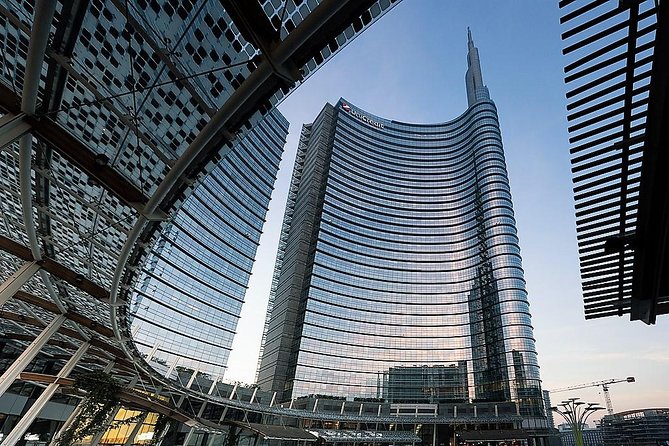
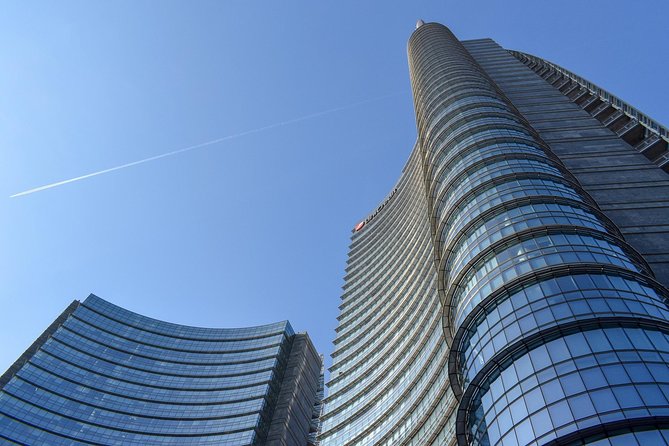
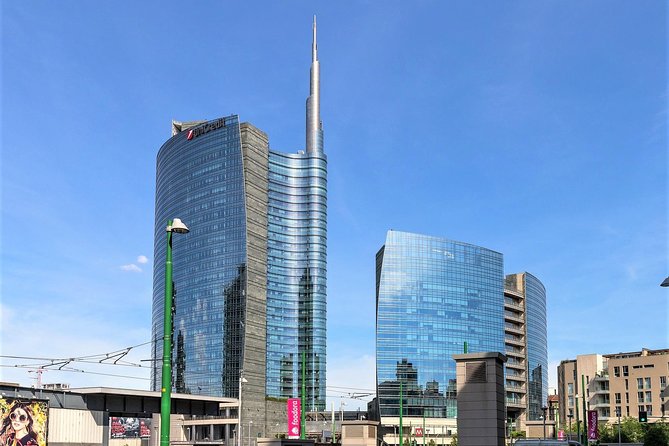
Gae Aulenti Square is the tour’s clearest showcase of Milan’s new skyline. The square is associated with the Unicredit Tower, identified as the tallest in Europe in the supplied tour details and one of the highest skyscrapers in Europe.
This is where you will likely spend time looking upward, comparing the tower with the surrounding buildings, and hearing how the project fits into Porta Nuova. The square gives you a strong sense of the new district’s scale, since the architecture is meant to be read from an open public setting rather than only from a street corner.
I like this stop for visitors who want more than a standard list of Milan’s historic monuments. The tower offers a direct way to discuss height, density, and the city’s attempt to project a modern identity. At the same time, the square is a public setting, not a guaranteed interior visit. The information does not include access to the Unicredit Tower, so plan on seeing and discussing it from the outside.
The route also mentions a dozen scenic terraces in the wider district. These can help you understand how the skyline looks from different angles, but the schedule does not specify which terraces are visited or whether any require admission. If a particular rooftop view is important to you, ask before booking.
Isola and the Vertical Forest towers
The walk then reaches Isola, a historic district with a very different character. Here, you will see railing houses with common galleries and courtyards, a form of housing that gives the area a more intimate scale than the new towers across the way.
That contrast is central to the tour. Isola lets you see older residential patterns before you look at the Vertical Forest towers. The route does not treat the towers as isolated curiosities. Instead, it places them beside existing homes and shows how two very different ideas about city living now share the same part of Milan.
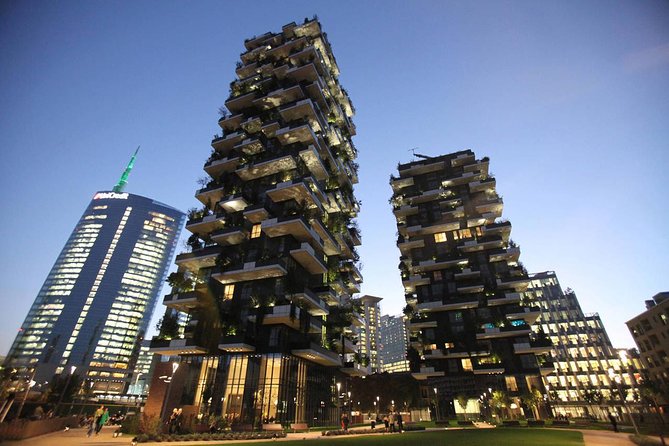
The Vertical Forest was designed as a model of urban reforestation and biodiversity. The supplied figures describe about 900 trees and more than 20,000 plants on the towers. Those numbers help explain why the buildings look different from ordinary high-rise apartments, with plantings spread across balconies and facades.
The project was rewarded in 2016 as the world’s most beautiful urban project, according to the tour information. That award is part of the story, but the more useful question is what the towers are trying to do. The concept is to add trees and plants within the existing city instead of expanding farther into open land.
You should keep your expectations practical. This is an architecture walking tour, not a visit inside the private apartments or a botanical garden tour. The value comes from viewing the buildings, understanding the planting concept, and comparing them with Isola’s older housing.
For me, this is the most memorable stop because it combines an easy-to-grasp visual idea with a serious urban question. Can a city add greenery by changing its buildings rather than spreading outward? Your guide can explain the project, while the nearby older homes show that Milan has always had its own forms of shared urban life.
What the private format adds
A private tour means only your group participates. That can be a real advantage at this price, especially if you are traveling with family or friends who want different levels of detail.
You can ask for more explanation of the Vertical Forest, keep the focus on design, or request a simpler overview if you are not an architecture specialist. The guide can also respond to your pace more easily than a large scheduled group, though the tour still lasts about three hours and follows the main route.
The word private does not mean every entrance or extra activity is included. The listed inclusions are a professional art historian guide and the private tour itself. Hotel transportation is not included, and the information does not list admission to a tower or terrace.
A moderate level of physical fitness is expected. You will be walking through several districts for roughly three hours, so comfortable shoes and sensible planning matter. The tour details do not give an exact distance, stair count, or accessibility plan, so ask Raphael Tours & Events if those points affect your decision.
Is $265.09 per person a fair price?
At $265.09 per person, this is not a bargain city walk. The price is easier to justify if you are splitting the experience with a small group and care about having a dedicated architecture guide rather than joining a standard group tour.
You are paying for concentration and context. In three hours, you cover Porta Nuova, Corso Como, Gae Aulenti Square, Unicredit Tower, Isola, the Vertical Forest, and Eataly. A guide who can connect those places into one story may save you time and help you notice details you would otherwise pass without understanding.
The value is weaker if you only want quick photos of the skyline. Most of the major sights are viewed from public areas, and no hotel transfer or clearly stated tower admission is included. You could see some of the district independently for less money, especially if you are comfortable reading up on the buildings beforehand.
I would consider this a better choice for architecture fans, design students, repeat visitors to Milan, and families or friends who want their own guide. First-time visitors who have only one day in Milan may prefer the city’s historic core, unless the modern side of the city is a top priority.
Practical details for planning your afternoon
The experience lasts about three hours and is usually booked well ahead, with an average booking lead time of 45 days. That does not mean you must book exactly that early, but it is a useful warning for anyone planning a fixed Milan schedule.
The tour is offered as a private activity, and group discounts are available. Since the price is listed per person, check how the final cost changes for your party before you commit. A larger group may find the private arrangement more reasonable than a couple paying the full per-person rate.
Mobile tickets are supported, and confirmation is received at booking. Free cancellation is available if you cancel at least 24 hours before the start time. Changes or cancellations inside that window are not accepted for a refund, and the cut-off follows local Milan time.
The meeting point is near public transportation, but there is no hotel pickup. Plan to arrive at Eataly Milano Smeraldo on your own and allow time to locate the exact meeting place. Since the route finishes there, you can also use Eataly as a convenient place to continue eating or browsing after the walk, though the tour details do not promise a full meal.
Who should book this Milan skyline walk?
I would book this tour if you want to understand Milan’s recent architectural change rather than spend another morning inside the historic center. The mix of Porta Nuova’s grand redevelopment, Corso Como’s street life, Gae Aulenti Square, and Isola’s older homes gives you a well-shaped route.
It also suits you if you enjoy asking questions. A private art historian guide can make the difference between simply seeing the Vertical Forest and understanding why it was built, how it relates to city growth, and what its planting scheme is meant to achieve.
I would hesitate if you are looking for extensive interior access, a rooftop admission, or a low-cost introduction to Milan. Those features are not clearly included. The three-hour walk also calls for moderate fitness and does not include transportation from your hotel.
Should you book it?
Book this experience if modern architecture, urban planning, and Milan’s changing identity interest you. The strongest part is the contrast between Isola’s historic railing houses and the Vertical Forest, backed by the dramatic setting of Unicredit Tower and Porta Nuova.
The private format and guide-led explanation make the price more defensible for a group than for one or two people. Before booking, confirm the exact meeting and Eataly timing, and ask about any terrace or tower access you consider essential. If you are happy with an outdoor walking tour and want a focused look at new Milan, this is a thoughtful choice.
FAQ
How long does the Milan skyscrapers tour last?
The tour lasts approximately three hours.
Is this a private tour?
Yes. Only your group participates, and a professional art historian guide leads the activity.
Where does the tour start?
The meeting point is Eataly Milano Smeraldo, Piazza XXV Aprile 10, 20121 Milan.
Where does the tour end?
The activity ends back at the meeting point at Eataly Milano Smeraldo.
Is hotel pickup included?
No. Hotel pickup and drop-off are not included. The meeting point is near public transportation.
What is the cancellation policy?
You can cancel for a full refund if you do so at least 24 hours before the experience start time. Cancellations or changes made less than 24 hours in advance are not accepted for a refund.
Just added around Milan
- Milan: Food Tour with Pasta, Pizza, Cannoli, and Tiramisu!★ 4.3 · 3 reviews
- Varenna Walking Tour and Cooking Class★ 5.0 · 3 reviews
- 1-Day Personal Fashion Styling Course for Women★ 5.0 · 3 reviews
- Milan: 4-Hour Art and History Private Walking Tour★ 5.0 · 3 reviews
- Private Wine Tasting in Bellagio with Chef Luigi Gandola★ 5.0 · 3 reviews
- Walking Tour in Lake Como with Lierna Cooking Class★ 5.0 · 3 reviews
- Mantova: Private Walking Tour★ 4.3 · 3 reviews
- Wine and Food tasting PRIVATE Guided Tour★ 5.0 · 3 reviews
Guided, compared.
City Sightseeing Hop-On Hop-Off Bus with Audio Guide
Read our review →
Guided Walking Tour & Last Supper Visit with Ticket
Read our review →
Fast-Track Milan Cathedral and Terraces Guided Tour
Read our review →
Duomo Rooftop and Cathedral Guided Tour with Tickets
Read our review →
Sforza Castle Entry Ticket with Digital Audio Guide
Read our review →