
Reviewed · MILAN
Miles and smiles /// Milan’s ride
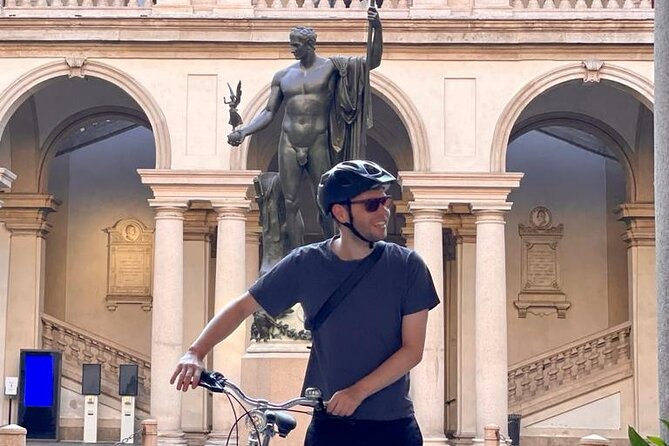
Milan reveals itself best when you keep moving. This four-hour bike ride links the Duomo and Sforza Castle with Brera, Navigli, leafy parks, modern towers, and ordinary city streets that a bus tour simply skips.
I like the small group size, which lets guides such as Giacomo and Stefano adjust the pace and answer questions. I also like the new Rossignoli bikes, included helmet, and bottled water. The main caution is urban traffic: you need to feel comfortable riding near cars, pedestrians, and narrow roads.
In This Review
- Key points at a glance
- Why a bicycle makes sense in Milan
- Starting in Moscova and reaching modern Milan
- Brera and the old center
- Sforza Castle, Sempione Park, and the Arch of Peace
- Cadorna, Sant’Ambrogio, and Milan’s quieter side
- Darsena, Navigli, and the canal district
- The Duomo, La Scala, and Milan’s grand center
- Palestro, Repubblica, and the Pirellone
- Bikes, group size, and the pace
- Is the $59.13 price good value?
- Weather, clothing, and practical preparation
- Who should book this Milan bike tour?
- Should you book it?
- FAQ
- Where does the Milan bike tour start?
- Where does the tour finish?
- How long does the tour last?
- How much does the tour cost?
- What kind of bicycle is provided?
- Is a helmet included?
- Is bottled water included?
- How many people can join the tour?
- What places does the route visit?
- Is the tour suitable for children?
- Can I cancel for a full refund?
Key points at a glance
- A wide-ranging route: Cover central Milan, Brera, Bosco Verticale, Sforza Castle, Navigli, and the Duomo in one ride.
- A genuinely small group: The additional tour details set the maximum at eight people, while the tour description says up to ten.
- Local guides with personality: Giacomo, Stefano, and Andrea are praised for their Milan knowledge, patience, humor, and care with safety.
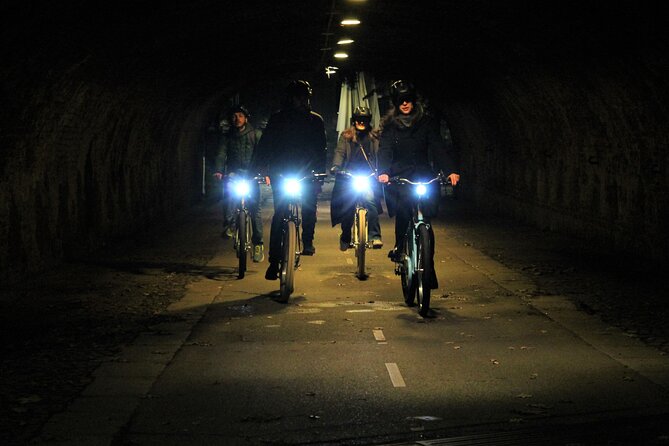
- Useful equipment included: You ride a new Rossignoli bike and receive a helmet and bottled water.
- Good first-day orientation: The route gives you a quick sense of Milan’s districts and helps you choose where to return later.
- Plan for city cycling: Milan is mostly flat, but traffic and busy public areas call for confidence on a bike.
Why a bicycle makes sense in Milan
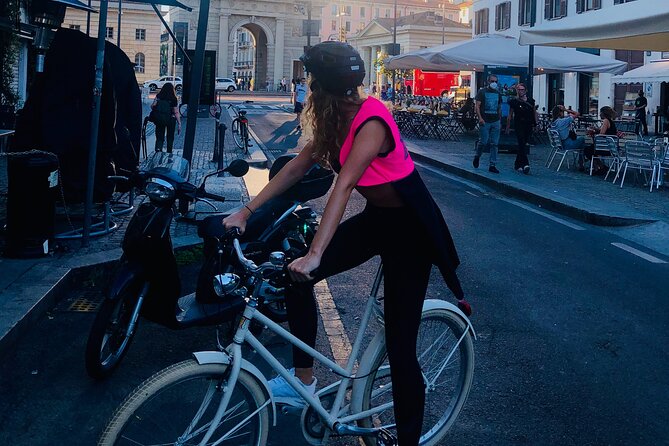
Milan is large enough that walking between its headline sights can eat up much of your day. Public transport helps, but it can leave you with a patchwork view of the city. A bicycle fills the gap. You cover ground quickly, yet you remain close enough to notice the change from office district to old quarter, from grand monument to local street.
This ride is not just a point-to-point trip between famous sights. It gives you a broad first look at Milan. You pass through central squares, parks, canals, residential areas, shopping streets, and newer parts of the city. That range is the real value.
The route also has a useful rhythm. You ride for a while, stop to take in a place, hear some background from the guide, and continue. The tour is scheduled for about three to four hours, with the main stop description allowing four hours. It is long enough to feel substantial without taking your whole day.
Milan is flat, which helps. Still, flat does not mean effortless. You need moderate physical fitness and enough bike control to handle an urban setting. One rider described the route as fine for a confident cyclist but not ideal for someone uneasy on busy streets. That is fair advice.
Other Milan trips people book alongside this one:
- Milan: Cathedral and Duomo’s Terraces Entrance Ticket
★ 4.6 · 61,054 reviews - From Milan: Como & Bellagio with Private Lake Como Cruise
★ 4.6 · 9,788 reviews - Milan: City Sightseeing Hop-On Hop-Off Bus with Audio Guide
★ 4.0 · 6,256 reviews
Starting in Moscova and reaching modern Milan
The meeting point is at Via della Moscova 26, in the Moscova area. It is near public transport, but make a little extra effort to identify the exact place before you set off. The start has been described as an empty playground, which can feel odd if you are expecting a shopfront or a large tour sign.
I would arrive early and keep the meeting instructions open on your phone. One useful feature of a small group is that a delayed arrival may be handled with some patience. Giacomo and Stefano have been praised for waiting for late arrivals and for being flexible when a day ran behind schedule, but you should still aim to arrive on time.
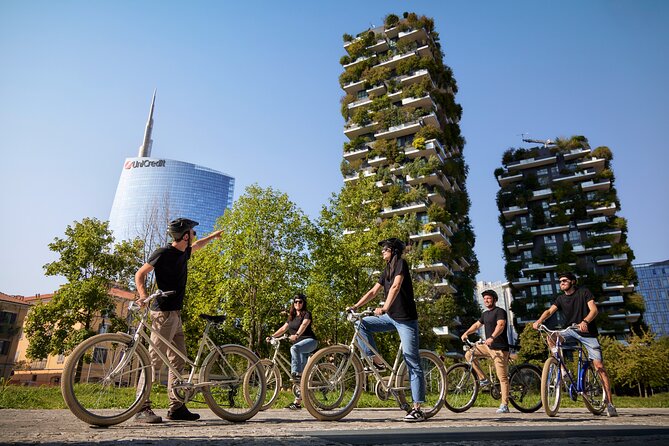
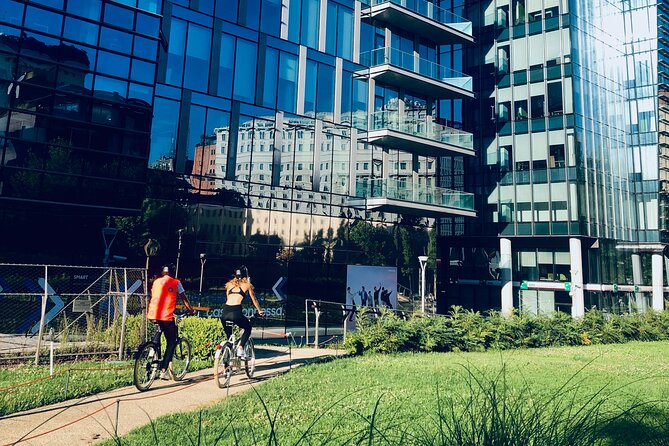
From Moscova, the ride heads toward Piazza Gae Aulenti, Milan’s modern showpiece. The square is ringed by contemporary buildings and gives you an immediate sense of the city’s newer face. Nearby Bosco Verticale, or Vertical Forest, adds another striking contrast. Its residential towers are covered with trees and plants, making this one of Milan’s most recognizable examples of modern architecture.
This opening section works well because it prevents Milan from becoming a collection of old churches and grand palaces. You see a city that is still changing, with new architecture close to traditional neighborhoods.
Brera and the old center
The route then moves into Brera, one of Milan’s most appealing central districts. Brera has a more intimate feel than the broad business avenues. Its narrow streets, art connections, and attractive buildings make it a fine place to see from a bike, as long as the group moves carefully around pedestrians.
From there, you reach the heart of old Milan. Piazza dei Mercanti is a particularly useful stop because it gives you a sense of the medieval city near the better-known cathedral area. The square is more enclosed and less instantly grand than the Duomo, but that is precisely why it helps you picture how Milan once worked.
Piazza della Borsa brings another layer, tied to finance and the city’s modern commercial life. The ride does not keep you in one historical period. Instead, it shows how Milan’s identity shifts from medieval civic center to business capital within a few minutes.
A guide adds real value here. On foot, you might pass through these spaces without understanding how they fit together. On a bike, you can pause without committing to a long stop at every site. Guides such as Giacomo are praised for explaining Milan in their own way and for answering both serious questions and the occasional silly tourist question.
Sforza Castle, Sempione Park, and the Arch of Peace
Sforza Castle is one of the major landmarks on the route. Its large walls and towers give the ride a strong visual change after the compact streets of the old center. You are not buying a museum admission as part of this activity, so think of the castle stop as an outside look and orientation rather than a full indoor visit.
That distinction matters. If you want to explore the castle museums, plan a separate visit. The bike ride gives you the setting and the chance to decide if the interior deserves more of your time later.
Beyond the castle, the route enters Sempione Park. This is one of the welcome breathing spaces in the middle of Milan. The park makes the ride feel less like a contest with traffic and more like a tour through the city’s public spaces. Frequent stops also keep the physical effort reasonable for many riders.
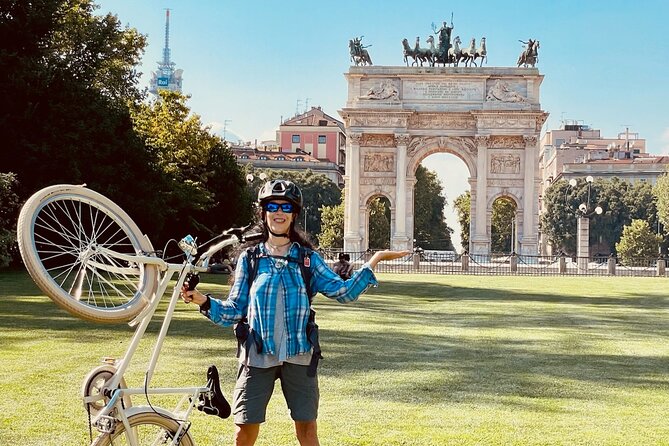
The Arch of Peace provides a grand endpoint to this section. Its broad scale and open setting make it easy to appreciate from a bicycle. The combination of castle, park, and arch is one of the most satisfying stretches of the trip because the sights connect naturally rather than feeling randomly assembled.
Hot weather can change the experience. A guide has been praised for adding water breaks on a very warm day, and bottled water is provided. Even so, bring sensible clothing and do not treat the included bottle as your only hydration plan for a four-hour ride.
A different sort of day out, same corner of Lombardy:
- Milan Cathedral: Duomo Terraces Ticket (No Church Access)
★ 4.6 · 6,111 reviews - Milan: Milan Cathedral Direct Entrance – Terrace Excluded
★ 4.5 · 5,782 reviews - Milan: Guided Walking Tour & Last Supper Visit with Ticket
★ 4.7 · 5,409 reviews - Milan: Fast-Track Milan Cathedral and Terraces Guided Tour
★ 4.7 · 5,240 reviews
Cadorna, Sant’Ambrogio, and Milan’s quieter side
After Sempione, the ride continues through the Cadorna area toward Sant’Ambrogio. This part helps you see Milan beyond the standard postcard route. Cadorna is a major city zone, while Sant’Ambrogio offers a calmer look at Milan’s older religious and civic character.
The strength of this section is not one single attraction. It is the change in atmosphere as you move between transportation corridors, quieter streets, and historic buildings. A bus can show you the same places, but you would have less sense of how close they are to one another and how the city changes block by block.
This is also where the guide’s handling of the group matters. You may ride on small roads, near cars, through areas with pedestrians, and around tourist sites. Guides are praised for watching the group and making safety a priority. That does not remove the need for alert riding, but it makes the experience more manageable.
The ride is informal rather than stiff. You should expect a guide who talks with you while keeping the group moving, not a lecture delivered at every corner. Giacomo in particular is described as friendly, flexible, and passionate about Milan and cycling. Guides may vary, and the tour can be operated by a multilingual guide.
Darsena, Navigli, and the canal district
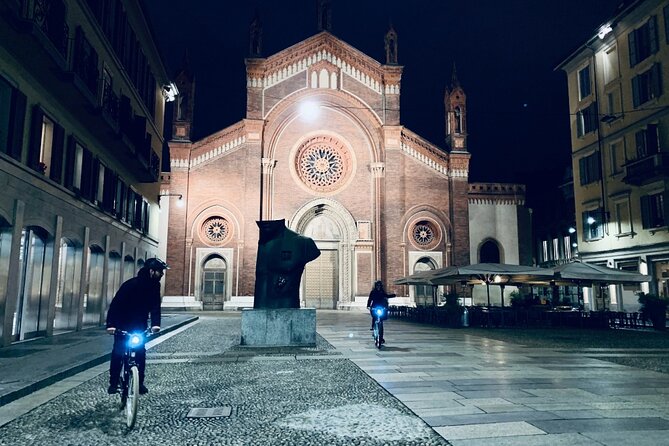
Darsena is one of the route’s most atmospheric changes. This former dock area connects with the Navigli district, known for its canals and evening social life. The water gives Milan a different mood, and the route lets you see this popular area without spending the entire day there.
Navigli is often best enjoyed slowly, especially if you want to sit for a drink or meal. The bike tour offers an overview, not a long canal-side stop. I would mark the area as somewhere to return after the ride, perhaps later the same day when you want a relaxed meal.
The canal district also shows why a bicycle is useful. You can reach it from the central sights without giving up a large portion of your afternoon. You also get a quick look at the streets around the canals, which can be crowded at certain times. Keep your attention on the road and follow the guide’s instructions.
From Darsena, the route goes toward the San Lorenzo Columns. These ancient Roman columns are a reminder that Milan’s past is older than its fashion and finance reputation suggests. Their setting near a lively urban area makes them especially interesting. You see history not in an isolated archaeological park, but as part of everyday city life.
The Duomo, La Scala, and Milan’s grand center
The Duomo is the big visual payoff. Reaching the cathedral after seeing so many different districts gives you a better sense of its place in the city. You approach it as part of a larger urban story, not as an isolated sight reached by a direct taxi ride.
The ride also includes Piazza San Fedele and La Scala. La Scala is one of the world’s best-known opera houses, and Piazza San Fedele adds another central civic setting. Via Manzoni then carries the group through one of Milan’s elegant central streets.
You should not expect an interior visit to the Duomo or La Scala. The tour is designed to show you the city from the outside and connect the sights by bike. If you want to climb the cathedral roof, attend a performance, or visit a museum, save those for a separate booking.
This central section can be busy. It is also the part where you need the most patience with pedestrians and traffic. The guide may lead you through crowded areas, but you remain responsible for riding carefully and dismounting if needed.
Palestro, Repubblica, and the Pirellone
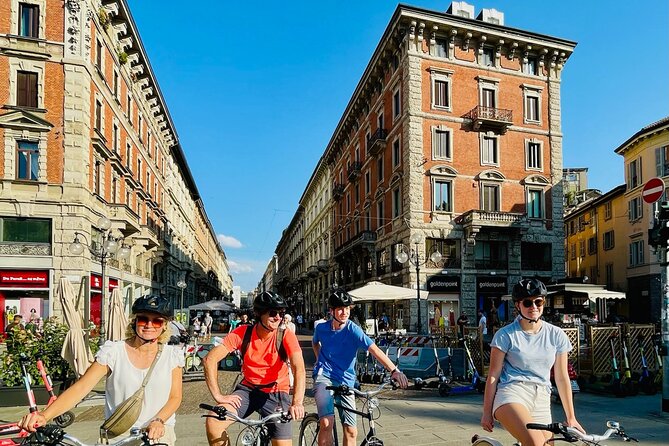
The final stretch takes you through Palestro and Repubblica before reaching Milan Central Station and the Pirellone. Palestro adds another polished central neighborhood, while Repubblica shows off the city’s broad modern avenues and office towers.
The Pirellone, officially the Pirelli Tower, is an important piece of Milan’s postwar architecture. Seeing it near Central Station rounds out the tour’s architectural range. You begin with Bosco Verticale’s current design language and end with a landmark from an earlier modern era.
Central Station is also a useful point of reference for your stay. The tour does not end there, however. You return to the Moscova meeting point, so allow time after the ride before arranging another activity.
The final loop may feel ambitious, but that is the point. You get a citywide orientation rather than a narrow neighborhood tour. If you are in Milan for only a short visit, this broad coverage can be worth more than a tour that spends four hours in one district.
Bikes, group size, and the pace
A new Rossignoli bike is supplied for the ride, along with a helmet and bottled water. Having the bicycle included keeps the booking simple, and a quality bike matters when you are riding for several hours through different parts of town.
The group is intentionally small. The tour information gives two maximums, up to ten in the main description and eight in the additional details. In either case, this is far smaller than a large coach group. At times, the group may be even smaller, including private-feeling rides for just two people or a solo booking.
Small groups allow the guide to speak with everyone and adjust the pace. That was especially useful for riders who needed water breaks or extra reassurance. It also makes it easier to ask about restaurants, later sightseeing, and practical Milan questions.
The pace is described as active but not relentlessly strenuous because the route includes regular stops. The Italian-language feedback is more cautious, noting that you need some stamina. Both points can be true. You may not finish exhausted, but you should not book this if you are uncomfortable cycling for several hours.
Is the $59.13 price good value?
At $59.13 per person, this is a reasonable price for a four-hour guided city ride with a bike, helmet, and water included. The value comes from the amount of Milan covered and the time saved moving between districts.
You are also paying for local interpretation and route management. A map can show you the Duomo, Navigli, and Sforza Castle, but it will not keep a group together through city traffic or help you understand how the sights relate to one another.
The tour is particularly good value early in your stay. You can use the route to choose where to return for a museum visit, a meal, or a slower walk. The guides also offer recommendations for things to do and places to eat, according to the experience details.
The price is less attractive if you want long visits inside major sights. Admission is not included, and the schedule does not leave room for full exploration of the Duomo, castle museums, or La Scala. Think of this as a moving city introduction, not a substitute for Milan’s indoor attractions.
Weather, clothing, and practical preparation
The activity requires good weather. If rain or other poor conditions cause cancellation, you are offered another date or a full refund. You can cancel for a full refund up to 24 hours before the start time, but changes or cancellations inside that window are not accepted.
Wear comfortable walking shoes, even though you will spend much of the time cycling. You may need to walk or stand during stops, and practical footwear is better than anything chosen only for style.
Children must be accompanied by an adult. The tour is intended for people with moderate physical fitness, and most people can participate if they are comfortable on a bicycle.
The most important preparation is honest self-assessment. You do not need to be a competitive cyclist, but you should be willing to ride in an urban setting. Busy streets, pedestrians, cars, shopping areas, and narrow roads are all part of the experience.
Who should book this Milan bike tour?
I would choose this ride if you want a broad first look at Milan and like the idea of seeing ordinary streets between major sights. It suits couples, solo riders, and small groups who prefer a personal guide to a large organized outing.
It is also a smart choice for a first day, especially if you want an active way to get over jet lag. The route covers enough ground to help you plan the rest of your visit, and Milan’s flat terrain works in its favor.
I would hesitate if you are nervous around traffic, tire quickly, or want long indoor visits at each attraction. A walking tour may feel calmer, and a sightseeing bus may be better if cycling is not your strength.
Should you book it?
Book this tour if you want a friendly, citywide introduction rather than a slow visit to one monument. Giacomo, Stefano, and Andrea are noted for their personal approach, safety awareness, flexibility, and love of Milan. The new Rossignoli bike, small group, water, and wide route add practical value.
Before booking, make sure you are comfortable on city streets and double-check the meeting point at Via della Moscova 26. If that fits you, this ride offers one of the better ways to understand Milan’s shape, neighborhoods, and contrasts in a single afternoon.
FAQ
Where does the Milan bike tour start?
The tour starts at Via della Moscova, 26, 20121 Milano MI, Italy.
Where does the tour finish?
The activity ends back at the meeting point on Via della Moscova.
How long does the tour last?
The tour lasts approximately three to four hours. The main stop description allows four hours.
How much does the tour cost?
The listed price is $59.13 per person.
What kind of bicycle is provided?
A brand new Rossignoli bike is used for the tour.
Is a helmet included?
Yes. A cycle helmet is provided.
Is bottled water included?
Yes. Complimentary bottled water is included.
How many people can join the tour?
The tour is designed for a small group. The additional details give a maximum of eight people, while the main tour information says the group can be capped at ten.
What places does the route visit?
The route includes Piazza Gae Aulenti, Bosco Verticale, Brera, Piazza dei Mercanti, Piazza della Borsa, Sforza Castle, Sempione Park, the Arch of Peace, Cadorna, Sant’Ambrogio, Darsena, Navigli, the San Lorenzo Columns, the Duomo, Piazza San Fedele, La Scala, Via Manzoni, Palestro, Repubblica, Central Station, and the Pirellone.
Is the tour suitable for children?
Children may participate if accompanied by an adult. Participants should also have a moderate level of physical fitness.
Can I cancel for a full refund?
Yes. You can cancel at least 24 hours before the start time for a full refund. Cancellations or changes made less than 24 hours before the start time are not accepted, and poor-weather cancellations offer a different date or a full refund.
Just added around Milan
- Milan: Food Tour with Pasta, Pizza, Cannoli, and Tiramisu!★ 4.3 · 3 reviews
- Varenna Walking Tour and Cooking Class★ 5.0 · 3 reviews
- 1-Day Personal Fashion Styling Course for Women★ 5.0 · 3 reviews
- Milan: 4-Hour Art and History Private Walking Tour★ 5.0 · 3 reviews
- Private Wine Tasting in Bellagio with Chef Luigi Gandola★ 5.0 · 3 reviews
- Walking Tour in Lake Como with Lierna Cooking Class★ 5.0 · 3 reviews
- Wine and Food tasting PRIVATE Guided Tour★ 5.0 · 3 reviews
- The art of the Italian Aperitivo with a local: Learn & Enjoy in Milan★ 4.5 · 3 reviews